
Immersive Visualization of Large-Scale Spatio-Temporal Datasets in Virtual Reality
Oceanographic datasets have grown substantially in size and complexity, making it difficult to explore spatial, temporal, and multivariate patterns with conventional 2D views alone. This thesis investigates Virtual Reality as an interactive environment for exploring large spatio-temporal oceanographic point datasets, using the COMFORT database as the primary target.
A particle-based VR prototype was implemented in Unreal Engine 5 with Niagara as the rendering backend. The system combines on-demand database loading, grid-based aggregation, temporal navigation, contextual spatial aids, and hand-driven shape-based subset selection. A formative user study (n = 9) showed that users could explore the data after a short familiarization phase, while onboarding and first-use comprehensibility remained the main weaknesses.
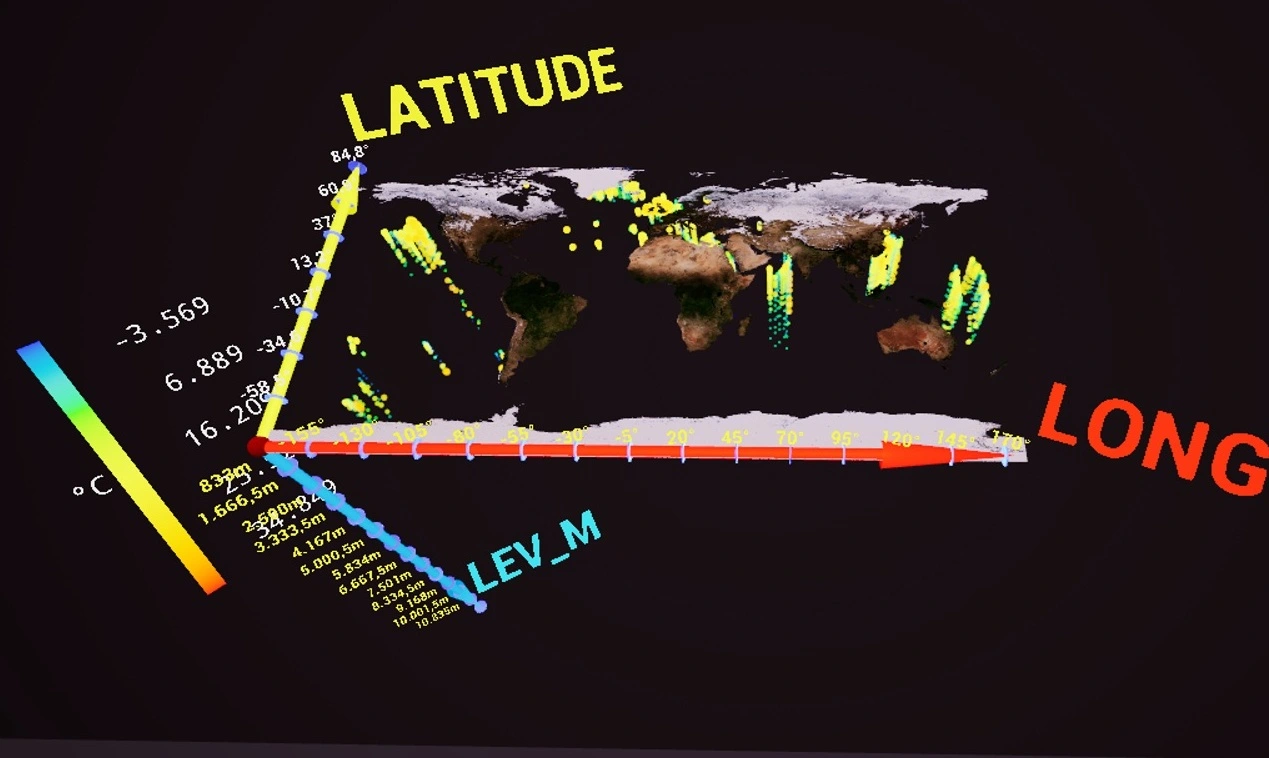
Description
The prototype follows a layered architecture that separates preprocessing, runtime data access, system control, visualization management, and rendering. A Python preprocessing step identifies compatible measurement tables in the SQLite database and prepares the database for efficient runtime access. At runtime, requested variables and time ranges are loaded asynchronously, so interaction in VR remains responsive.
Small subsets are displayed directly, while larger ones are reduced through grid-based aggregation into representative particles. Longitude, latitude, and depth are mapped to an in-scene coordinate system with adjustable depth scaling. Values are encoded through particle color, opacity, and size, supported by axes, labels, a legend, and a flat world-map overlay for spatial orientation.
For analysis in dense point fields, the system provides shape-based subset selection. Users can place configurable cone, sphere, box, or capsule volumes directly in the scene with one or both hands. The resulting subset is highlighted as an additional visualization layer and summarized through basic statistics.
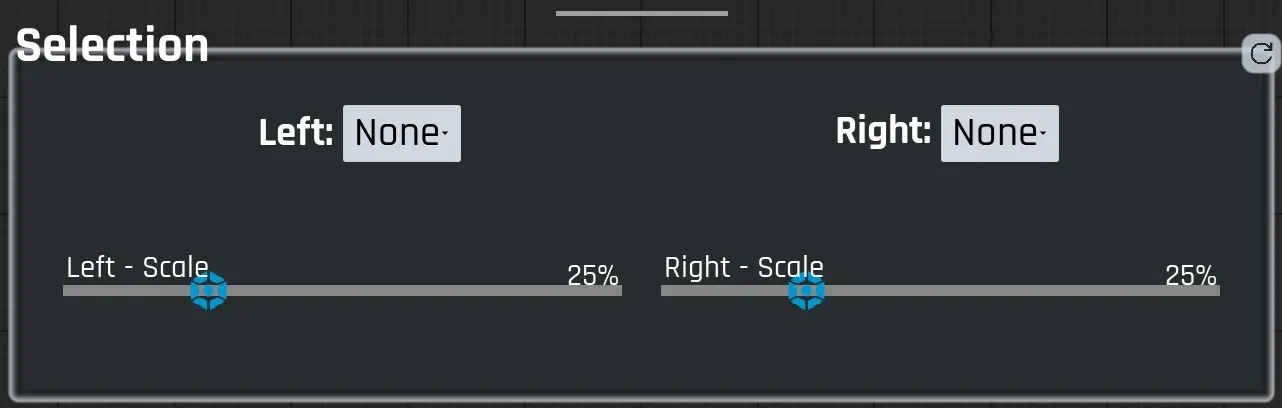
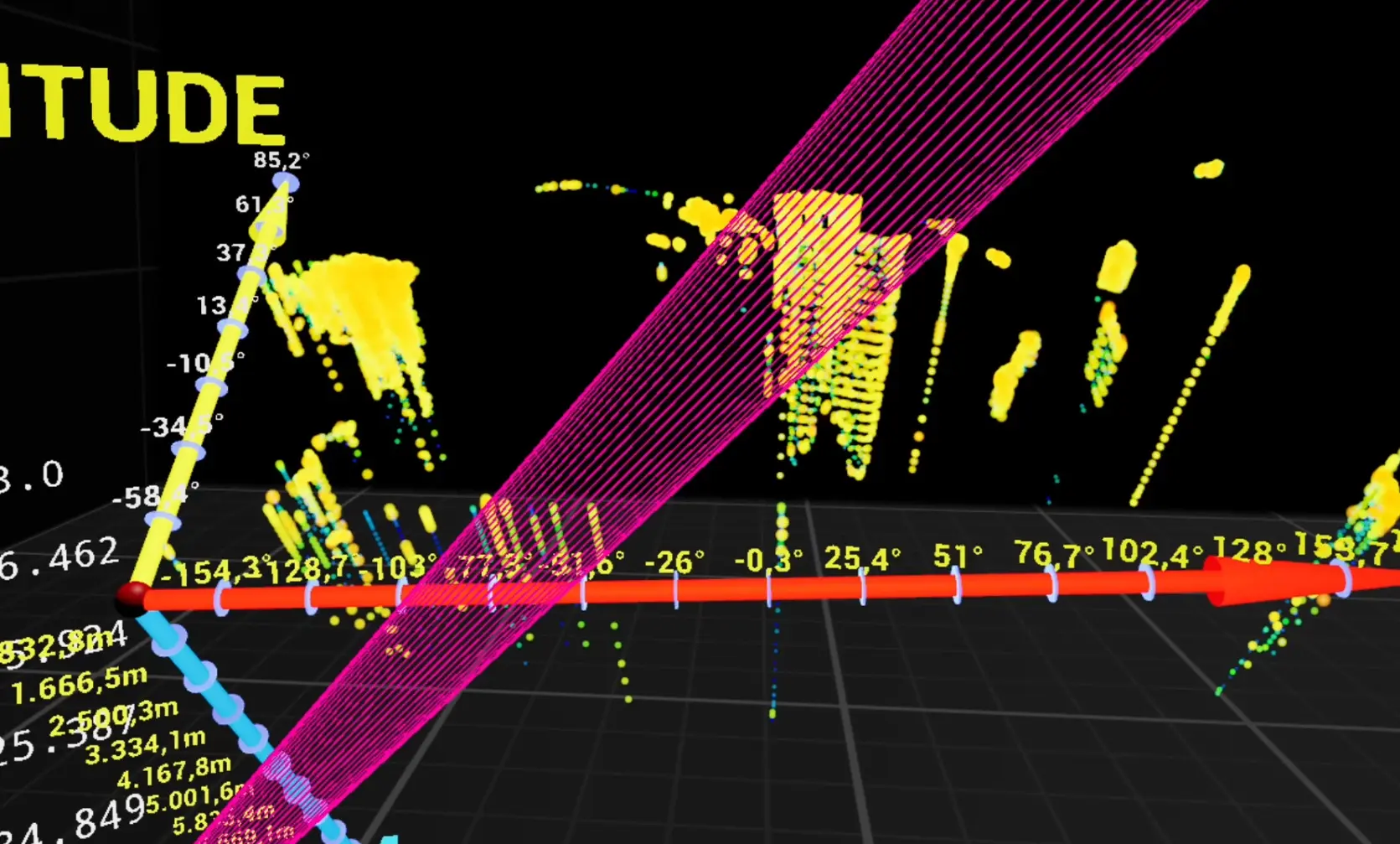
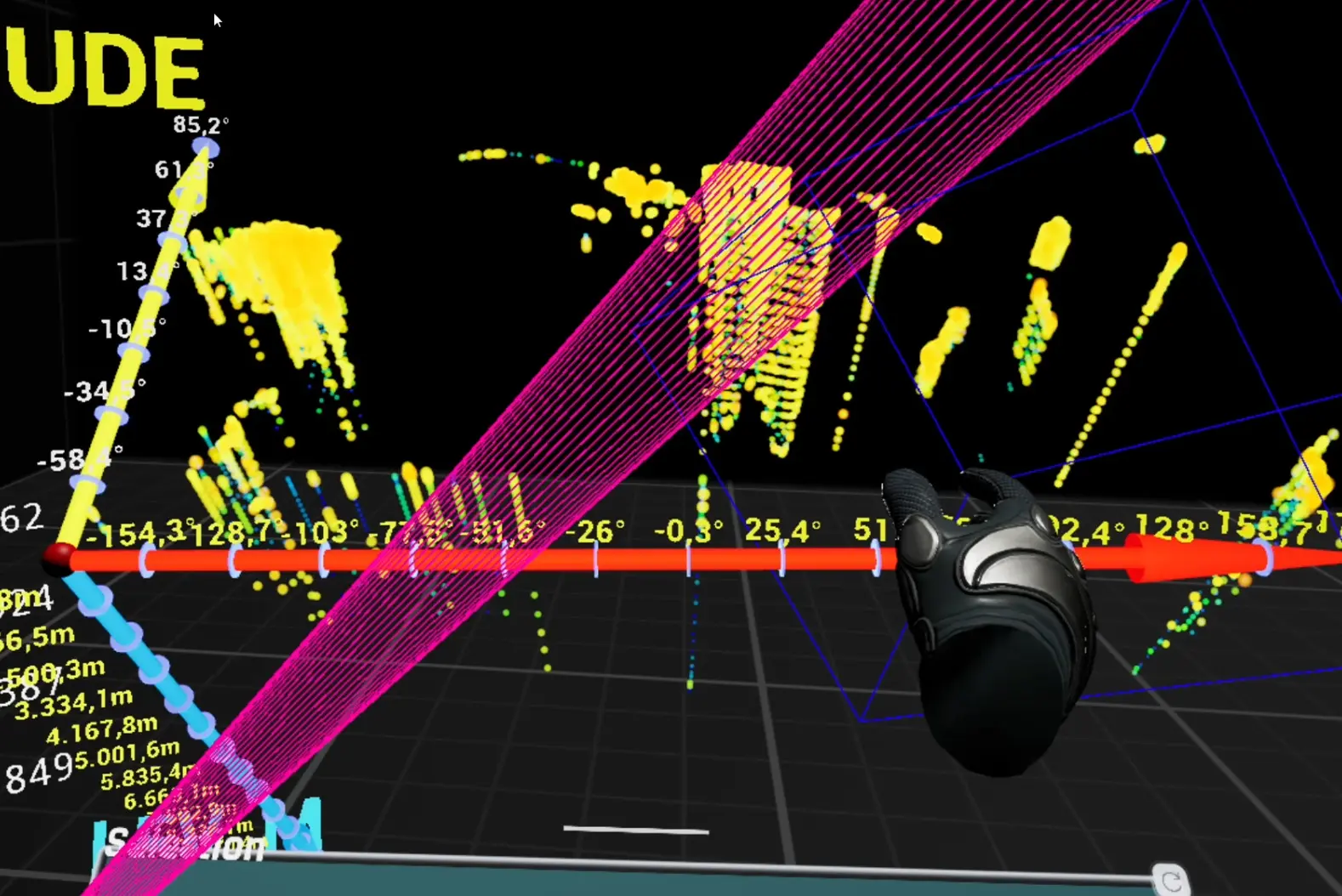
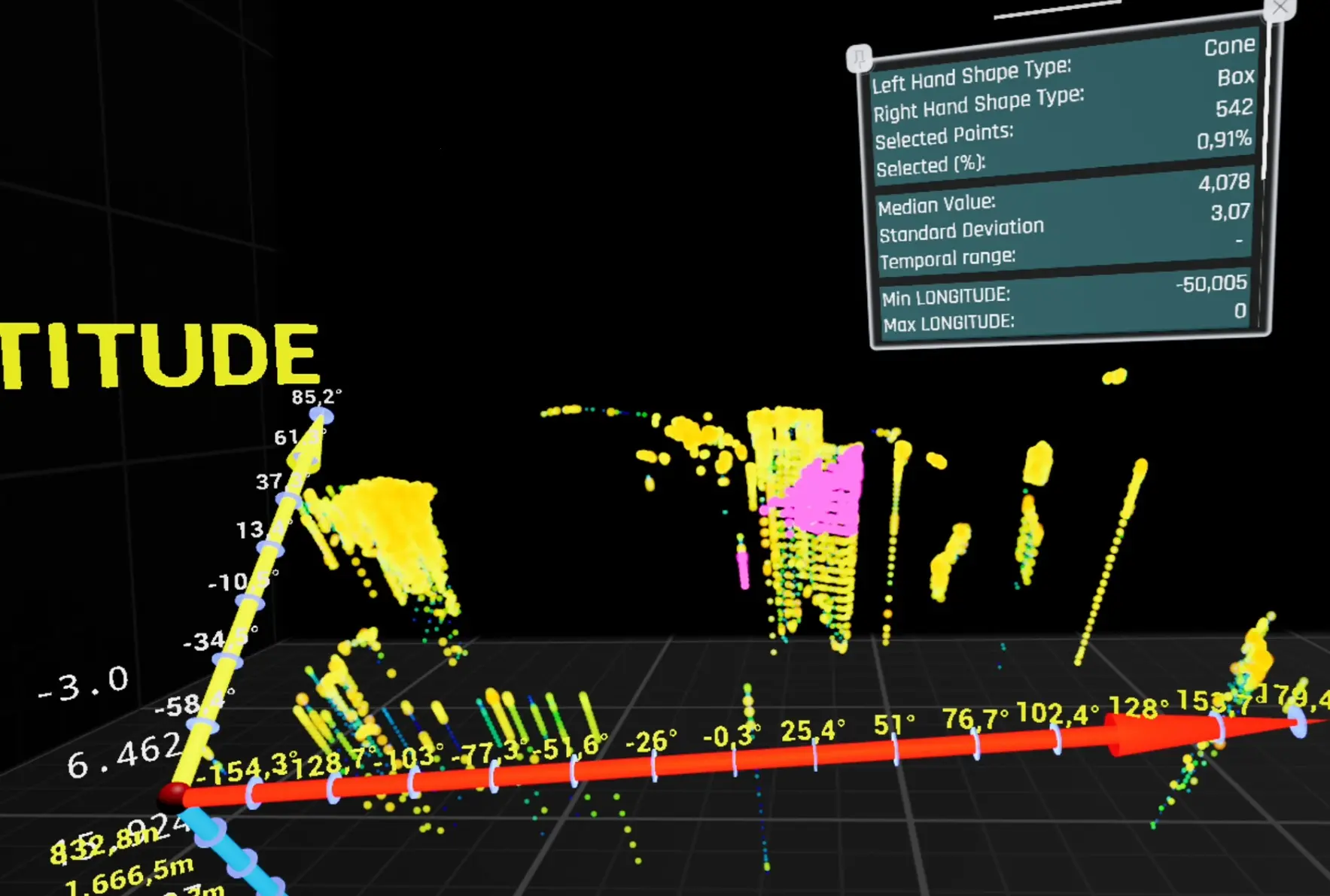
Shape-based selection workflow: configuration, positioning of the selection volume, one- or two-handed use, and highlighted result with summary statistics.
Results
The final formative user study involved nine previously untrained participants with mixed VR experience. Each session combined guided VR tasks, SUS and UEQ questionnaires, observation notes, and a semi-structured interview.
The mean SUS score was 54.4, with a standard deviation of 9.8. The UEQ results were more differentiated: Stimulation was rated as Excellent, while Attractiveness, Efficiency, Dependability, and Novelty were rated as Good. Perspicuity, however, was rated Below Average, pointing to limited immediate comprehensibility. In the qualitative feedback, users especially highlighted the spatial context, core VR interactions, and subset visualization positively, while onboarding remained the main area for improvement.
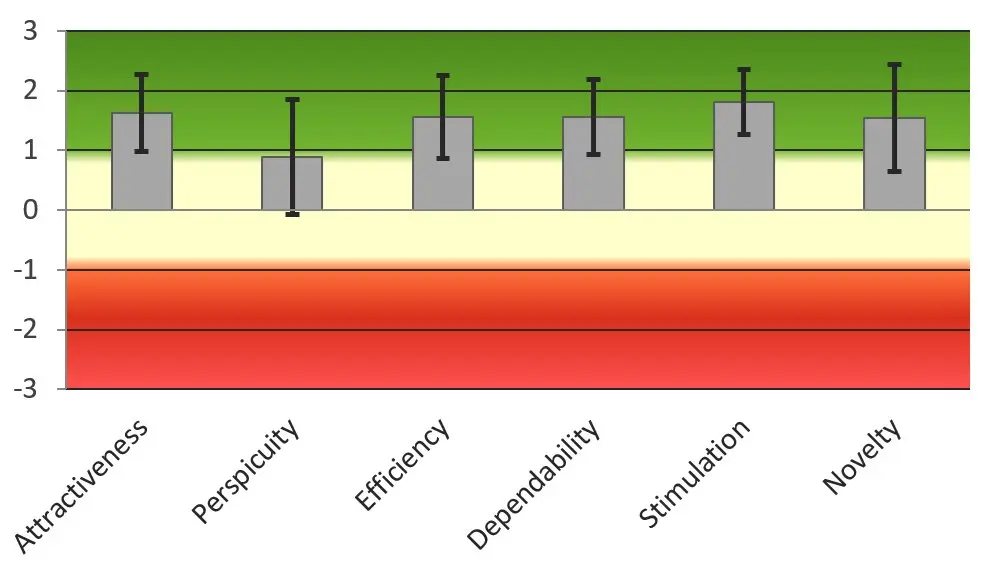
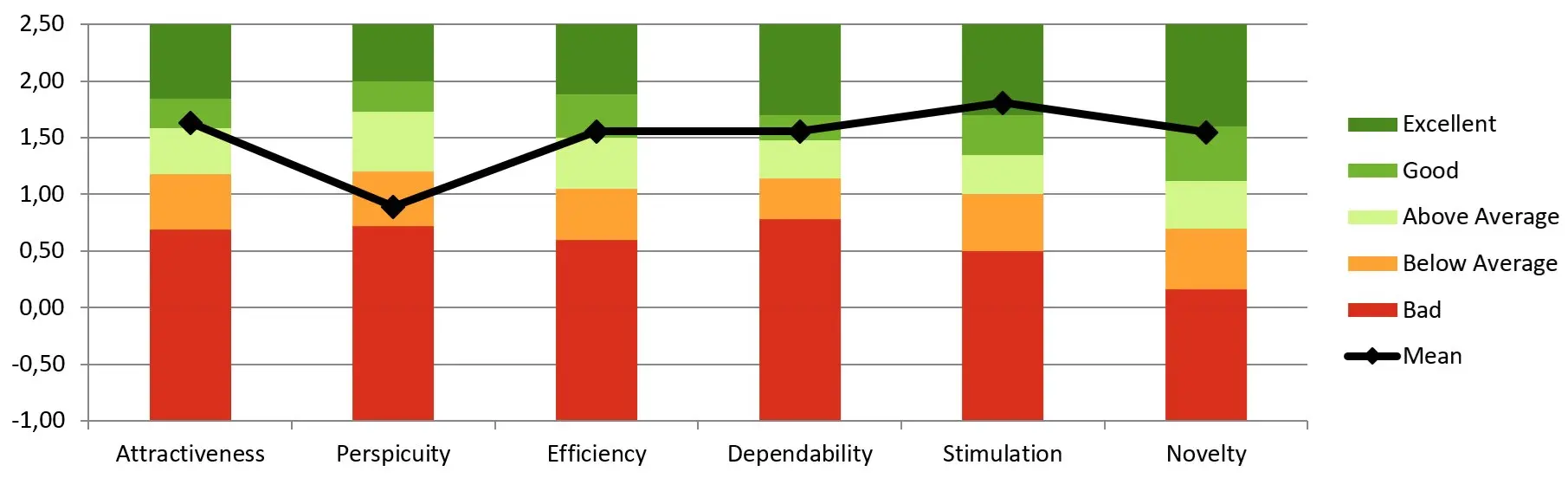
UEQ scale means with standard error (left) and the same means compared against the UEQ benchmark dataset (right).
Files
Full version of the master's thesis (English only)
Presentation of the thesis can be found here
Source code repository can be found here
License
This original work is copyright by University of Bremen.
Any software of this work is covered by the European Union Public Licence v1.2.
To view a copy of this license, visit
eur-lex.europa.eu.
The Thesis provided above (as PDF file) is licensed under Attribution-NonCommercial-NoDerivatives 4.0 International


 .
.
Any other assets (3D models, movies, documents, etc.) are covered by the
Creative Commons Attribution-NonCommercial-ShareAlike 4.0 International License.
To view a copy of this license, visit
creativecommons.org.
If you use any of the assets or software to produce a publication,
then you must give credit and put a reference in your publication.
If you would like to use our software in proprietary software,
you can obtain an exception from the above license (aka. dual licensing).
Please contact zach at cs.uni-bremen dot de.